Hair loss affects millions of men and women and remains one of the most frustrating age-related conditions. While medications such as minoxidil and finasteride have been the standard of care for decades, newer regenerative therapies are beginning to change the conversation. A recent study published in Clinics in Dermatology, entitled Microneedling Radiofrequency Followed by Topical Exosome Application Therapy for Pattern Hair Loss: A Scoping Review and Prospective Study, highlights one of the most exciting developments in modern hair restoration: the combination of microneedling and exosome therapy.
At The Hormone Zone, we believe that successful hair restoration requires more than simply trying to force hair growth. Healthy hair depends upon healthy follicles, proper circulation, effective cellular communication, balanced hormones, adequate nutrition, and a healthy scalp environment. The emerging science of regenerative medicine aims to support these biological processes rather than simply masking the symptoms of hair loss.
Understanding Pattern Hair Loss
The study focused on androgenetic alopecia, commonly known as male or female pattern hair loss. According to the authors, hair loss is a multifactorial condition influenced by genetics, hormonal signaling, inflammation, aging, oxidative stress, and alterations in hair follicle biology.
Over time, susceptible hair follicles undergo a process called miniaturization. As follicles shrink, hairs become thinner, shorter, and less pigmented until growth eventually stops altogether. Traditional therapies attempt to slow this process, while regenerative therapies seek to improve the biological environment surrounding the follicle.
Hair Loss Treatments Reviewed in the Study
The authors reviewed numerous current and emerging therapies for androgenetic alopecia.

One of the most notable observations from the review was that every exosome study identified by the authors demonstrated positive effects on hair growth parameters.
What Are Exosomes?
Exosomes are microscopic extracellular vesicles released by cells. They act as biological messengers, carrying proteins, growth factors, messenger RNA, microRNA, cytokines, and other signaling molecules between cells.
Rather than functioning as living cells themselves, exosomes help coordinate communication throughout tissues. In hair follicles, exosomes may influence several key biological pathways involved in growth and regeneration.
The article specifically discusses how exosomes may support:
- Wnt/β-catenin signaling
- Dermal papilla cell activity
- Angiogenesis
- Follicular stem cell signaling
- Reduction of inflammatory pathways
- Hair cycle regulation
These mechanisms are important because healthy follicular communication is essential for maintaining active hair growth.
How Exosomes Were Applied in the Study
One of the most interesting aspects of this research is that the exosomes were not injected into the scalp.
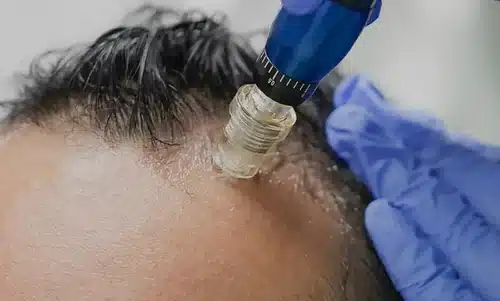
Instead, the investigators performed microneedling radiofrequency first and then immediately applied a topical exosome solution onto the treated scalp. The microscopic channels created during the microneedling procedure allowed the exosomes to penetrate deeper into the scalp tissue and interact with the follicular environment.
This delivery method combines two separate regenerative mechanisms:
- Microneedling stimulates the scalp’s natural healing response.
- Exosomes provide regenerative signaling molecules that help direct tissue repair.
The authors hypothesized that this combination creates a synergistic effect that may be more effective than either therapy alone.
How The Hormone Zone Expands Upon This Delivery Model
The study utilized exosomes alone following microneedling. At The Hormone Zone, we build upon this regenerative concept by utilizing both VittiPure® PDGF and EV-Pure™ Exosomes following microneedling.
Historically, many regenerative hair restoration protocols have relied upon Platelet-Rich Plasma (PRP) as the primary source of growth factors. While PRP can be beneficial, it is inherently limited by patient variability. The quality of PRP depends upon platelet concentration, patient age, metabolic health, inflammation levels, medications, and processing technique. As a result, one patient’s PRP can be dramatically different from another’s.
VittiPure® PDGF represents a next-generation regenerative approach designed to provide highly concentrated platelet-derived growth factor signaling without the variability associated with traditional PRP. Because PDGF is one of the most important growth factors involved in tissue repair, angiogenesis, cellular recruitment, and wound healing, many regenerative physicians view concentrated PDGF therapy as a more advanced and potentially more potent alternative to traditional PRP protocols.
For this reason, we often describe VittiPure® as a regenerative evolution of PRP. Rather than relying solely on the patient’s ability to produce growth factors, VittiPure® provides a highly concentrated source of one of the body’s most important regenerative signaling molecules.
Following application of VittiPure®, EV-Pure™ Exosomes are applied to further support cellular communication, follicular signaling, angiogenesis, and tissue repair. The microneedling channels facilitate delivery of both therapies directly into the scalp environment where follicular regeneration occurs.
Results of the Study
The prospective portion of the study followed 20 patients with androgenetic alopecia, including both men and women.
Patients underwent three treatment sessions spaced approximately one month apart. Hair density and hair shaft diameter were evaluated using clinical photography and trichoscopy over a median follow-up period of approximately ten months.
The results were encouraging.
The researchers found statistically significant improvements in:
- Hair density
- Hair shaft diameter
- Overall patient satisfaction
Importantly, no significant adverse events were reported during the study period.
The authors also noted that treatment response appeared independent of both sex and severity of hair loss, suggesting that a broad range of patients may potentially benefit from this regenerative approach.
Why Microneedling Matters
Many people think of microneedling simply as a method for delivering products into the skin. While improved delivery is certainly one benefit, the procedure itself produces significant biological effects.
Microneedling creates thousands of controlled micro-injuries that stimulate:
- Growth factor release
- Collagen production
- Increased circulation
- Tissue remodeling
- Wound-healing pathways
These biological responses help create a more favorable environment for follicular repair and regeneration.
The addition of VittiPure® PDGF and EV-Pure™ Exosomes may further amplify these regenerative pathways.
The Hormone Zone Hair Restoration Protocol
Our regenerative hair restoration protocol is designed to combine mechanical stimulation, growth factor signaling, and cellular communication.
Step 1: Microneedling
Microneedling creates controlled microchannels in the scalp while stimulating the body’s natural repair mechanisms. This process helps activate growth factor signaling, increase circulation, and improve the scalp environment.
Step 2: VittiPure® PDGF
VittiPure® PDGF is applied to the treated scalp to provide concentrated platelet-derived growth factor signaling. PDGF plays a central role in tissue regeneration, angiogenesis, wound healing, and follicular support.
Step 3: EV-Pure™ Exosomes
EV-Pure™ Exosomes are then applied to provide biologically active signaling molecules that support cellular communication, follicular health, tissue repair, and regenerative activity.
Together, these therapies are designed to create an optimal regenerative environment for healthier, thicker, and more resilient hair growth.
Looking Beyond the Hair Follicle
Hair restoration should never focus solely on the scalp.
At The Hormone Zone, we evaluate many of the underlying factors that can contribute to hair loss, including hormone imbalances, thyroid dysfunction, nutritional deficiencies, metabolic health, inflammation, stress, and accelerated aging.
Addressing these root causes while supporting the scalp with regenerative therapies provides a more comprehensive strategy than relying on a single treatment alone.
The Future of Hair Restoration
The study’s most important message is that hair restoration is moving toward regenerative combination therapies. Rather than focusing exclusively on blocking hormones or stimulating follicles with a single medication, researchers are increasingly exploring therapies that improve cellular communication and support the body’s natural regenerative processes.
While larger randomized trials are still needed, the results of this study suggest that microneedling combined with topical exosome therapy may represent a promising new direction for patients seeking non-surgical hair restoration.
At The Hormone Zone, we believe the future of hair restoration lies in combining advanced regenerative technologies such as concentrated growth factor therapy and exosome signaling with a comprehensive longevity-based approach to health. Healthy hair begins with healthy biology, and regenerative medicine is helping us better understand how to support that process.
Source
Koumprentziotis IA, Kroumpouzos E, Delavar S, Kroumpouzos G. Microneedling Radiofrequency Followed by Topical Exosome Application Therapy for Pattern Hair Loss: A Scoping Review and Prospective Study. Clinics in Dermatology. 2025.