Why Optimizing Your Hormones May Be the Missing Piece in Musculoskeletal Health
By Dr. John A. Robinson
When most people think about hormones, they think about energy, metabolism, libido, or menopause. Those are certainly important, but I believe hormones influence something even more fundamental: how every tissue in the body responds to stress, repairs itself, and ultimately becomes stronger.
For years, we have understood that exercise stimulates muscles to grow and bones to become denser. What has become increasingly clear is that this process is not driven by exercise alone. Exercise provides the stimulus, but hormones help determine how effectively the body interprets that signal. A landmark review published in Endocrine Reviews reinforces something I have observed throughout my years in clinical practice: hormones and mechanical loading work together to determine whether our muscles, tendons, ligaments, cartilage, and other connective tissues adapt, repair, or deteriorate.
Exercise Is a Biological Message
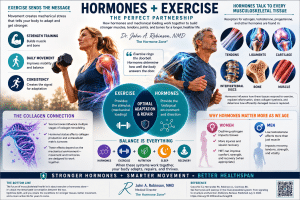
I often tell my patients that every time they lift a weight, walk up a hill, play pickleball, or climb a flight of stairs, they are sending a biological message to their body. That message is simple: become stronger.
What many people do not realize is that the body does not respond simply because force was applied. Specialized cells within our tissues sense mechanical stress and convert it into biochemical signals through a remarkable process known as mechanotransduction. Those signals stimulate collagen production, remodel connective tissue, strengthen bone, and repair microscopic damage.
I like to explain it this way: exercise rings the doorbell, but hormones determine how well the body answers the door. Without the proper hormonal environment, that message may be weaker, slower, or far less effective.
Hormones Do More Than Build Muscle
One of the biggest misconceptions I encounter is that testosterone is simply a muscle-building hormone and estrogen is only important for reproduction. The science tells a much more interesting story.
Nearly every musculoskeletal tissue contains receptors for estrogen, testosterone, progesterone, and other signaling molecules. These receptors are found throughout tendons, ligaments, cartilage, meniscus, intervertebral discs, bone, and skeletal muscle. When hormones bind to these receptors, they influence how tissues respond to exercise, regulate inflammation, direct collagen synthesis, and determine how efficiently damaged tissue is replaced with stronger, healthier tissue.
To me, hormones are not simply growth factors. They are biological communicators that teach tissues how to respond to movement, injury, recovery, and the normal stresses of everyday life.
The Collagen Conversation
Collagen is the primary structural protein that gives tendons, ligaments, cartilage, skin, and fascia their strength. As we age, collagen production naturally slows, microscopic injuries accumulate, repair becomes less efficient, and pain often follows.
The review demonstrates that sex hormones influence multiple stages of collagen remodeling. Hormonal status affects collagen production, extracellular matrix turnover, and the incorporation of newly synthesized collagen into connective tissue. Just as importantly, these effects depend heavily on the surrounding mechanical environment, meaning that movement and hormones were designed to work together rather than independently.
This helps explain why I never view hormone therapy as a stand-alone treatment. Replacing hormones without movement often produces incomplete results, while exercising aggressively in the setting of significant hormone deficiency may limit the body’s ability to repair and adapt. Biology works best when these systems are coordinated.
Why Menopause Changes Musculoskeletal Health
One of the most common complaints I hear from women after menopause is that injuries suddenly seem to occur more easily. Shoulders become stiff, Achilles tendons begin hurting, plantar fasciitis develops, and recovery after exercise takes much longer than it once did.
I do not believe this is simply “getting older.” Declining estrogen changes how connective tissues sense mechanical load, remodel themselves, and maintain their extracellular matrix. The review describes estrogen receptors throughout musculoskeletal tissues and explains how estrogen signaling influences mechanotransduction, collagen turnover, and tissue adaptation.
Understanding these biological changes helps explain why carefully selected women often notice improvements in joint comfort, exercise tolerance, and recovery when hormone therapy is appropriately prescribed as part of a comprehensive treatment plan.
Testosterone Is About More Than Strength
In men, testosterone has traditionally been viewed through the narrow lens of muscle size. While it certainly contributes to lean body mass, I believe its role is much broader.
The review describes how testosterone influences cellular signaling, cytoskeletal organization, and the pathways responsible for adapting to mechanical loading. Testosterone appears to support normal mechanotransduction and connective tissue remodeling, allowing tissues to respond more effectively to the stimulus of exercise.
This may help explain why men with low testosterone frequently report not only fatigue and declining strength, but also slower recovery, persistent tendon pain, decreased athletic performance, and recurrent musculoskeletal injuries.
Hormones Cannot Replace Exercise
One of the most important lessons from this paper is that hormones cannot replace exercise, just as exercise cannot fully overcome significant hormone deficiency. The two systems are biologically intertwined.
Mechanical loading activates the signaling pathways, while hormones amplify, regulate, and direct those signals toward adaptation and repair. That is one reason I encourage my patients to continue resistance training throughout life—even during rehabilitation or while beginning hormone optimization.
The goal is not to train harder. The goal is to consistently provide the body with intelligent mechanical stimulation that reminds it to preserve muscle, collagen integrity, balance, strength, and mobility.
Why This Matters in Longevity Medicine
People often define longevity by how many years they live. I define it by how well they live those years.
A longer life has little value if every step hurts, shoulders cannot lift overhead, knees prevent travel, or back pain keeps someone from playing with grandchildren. Preserving musculoskeletal function is one of the greatest investments we can make in healthy aging. Strong muscles reduce falls, healthy tendons improve mobility, resilient cartilage preserves independence, and well-maintained connective tissue allows people to remain active for decades longer.
Hormones are not the entire answer, but they are an essential part of creating an internal environment where those adaptations can occur.
My Philosophy at The Hormone Zone
At The Hormone Zone, I have never viewed hormone optimization as an isolated therapy. I view it as one component of a much larger biological ecosystem.
Hormones create an internal environment where tissues can respond more effectively. Exercise provides the mechanical stimulus. Proper nutrition supplies the building blocks. Sleep supports repair, and recovery prevents chronic overload. When these systems work together, my patients do not simply feel better—they become stronger, more resilient, and better equipped to meet the physical demands of everyday life.
This review reinforces a principle that has become central to the way I practice medicine: the future of musculoskeletal health is not simply about understanding exercise or understanding hormones. It is about understanding the remarkable conversation between the two. When I optimize both, I create the conditions for healthier joints, stronger connective tissues, better movement, and a more active life for my patients.
That is ultimately what I believe longevity medicine should strive to achieve—not simply helping people live longer, but helping them live better.
Reference
Colicchio CJ, Hernandez PA, Robinson JL, Connizzo BK. Sex hormones and exercise in the musculoskeletal system: from signaling to structure and function. Endocrine Reviews. Published July 3, 2026.