Comprehensive Hormone Balance is the Foundation of Health and Performance
One of the most effective ways to improve your health at any age is to ensure you have the optimal levels of hormones, and that those hormones are functioning at their best. Hormones are the body’s messengers, responsible for delivering vital and complex signals that orchestrate healing, recovery, regeneration, and performance. Without the right hormone balance, the body begins to break down at the cellular level and becomes more vulnerable to the effects of aging, inflammation, infection, and dysfunction.
Drs. John Robinson and Cristina Romero-Bosch of The Hormone Zone have been at the leading edge of longevity and wellness medicine, including hormone replacement therapy, long before it became a trend, providing elite concierge service and holistic comprehensive care to patients in the Valley. During that time, while other competitors have been trying to get on board, we’ve been perfecting our medical protocols and expanding our service offerings to provide you with the personalized, tailored treatment plans you deserve to live a healthy, exceptional life.
At The Hormone Zone, you won’t be shuffled around or stuck with a generic checklist. Instead, you’ll receive the latest in leading-edge therapies, backed by in-depth data measurements, overseen directly by our physicians, and complemented by other services designed to maximize results. What’s more, our physicians work with you every step of the way to make sure the hormone replacement treatment you’re receiving is the right one for the best outcomes; if it’s not, we’ll pivot and adjust until we find the right one, because “good enough” simply isn’t.
The 5 Hormone Zones
There are 5 areas—or zones—of hormone imbalance.
1. Sex hormones. Estrogen, progesterone, and testosterone are the most common sex hormones and play key roles in sexual health, reproductive health, and cellular health for both men and women. Imbalances with any of these hormones can cause symptoms like fertility and menstrual problems in women, low libido and decreased sexual performance in men, and an increase the risk of certain cancers in both genders.
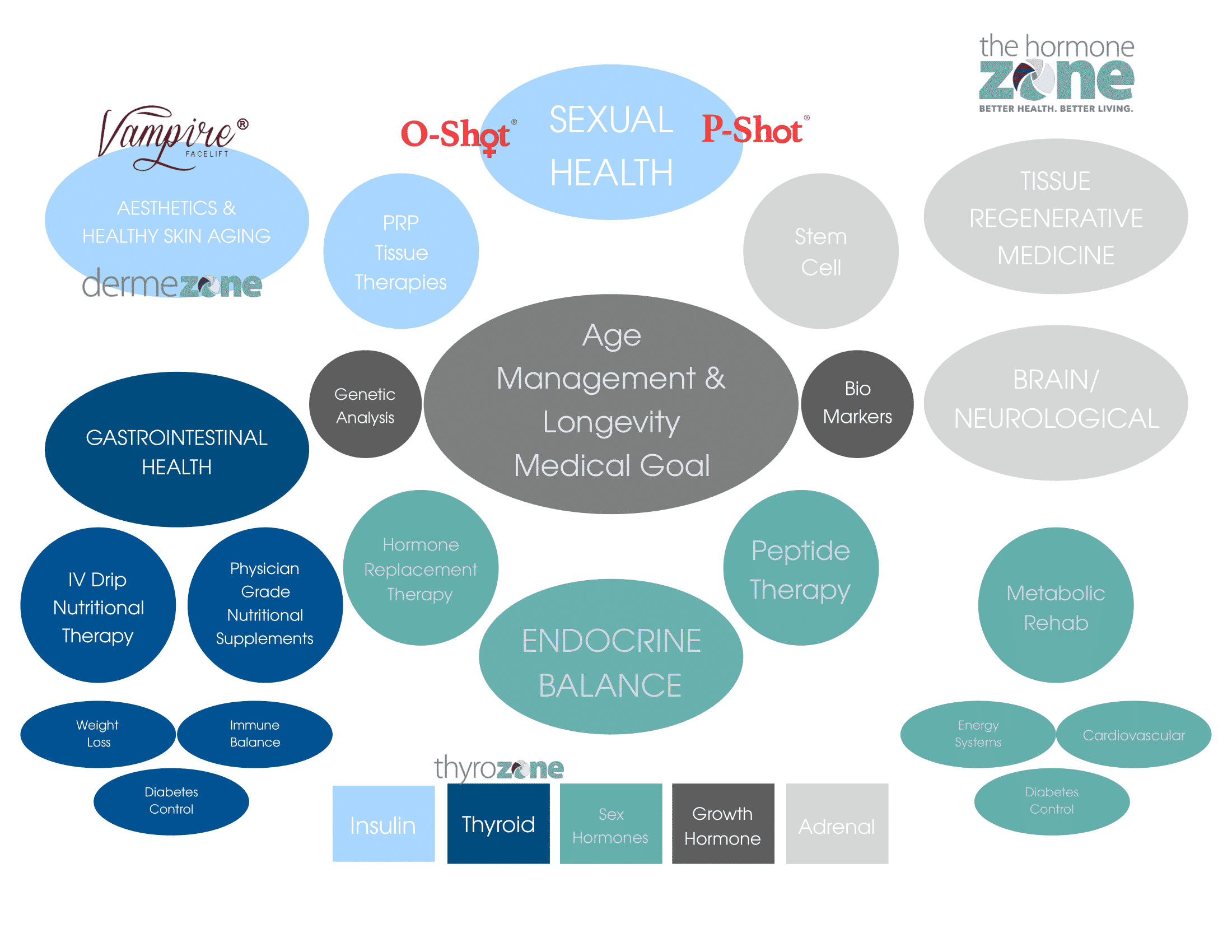
2. Thyroid hormone imbalance. The thyroid and the hormones it produces are essential in a plethora of bodily functions, especially in regulating metabolism. However, the thyroid is extremely sensitive to toxins, stress, and micronutrient depletion, resulting in overactivity or underactivity, and symptoms like fluctuating weight, mood, and energy levels and problems with the gastrointestinal system.
3. Adrenal. Cortisol is a stress or steroid hormone produced by the adrenal glands. Chronic and prolonged stress can affect how your body releases cortisol—either too much or too little—and lead to symptoms like fatigue, weight loss resistance and weight gain, and cravings for sugar, carbs, and caffeine. Adrenaline is another stress hormone that, if overproduced, can result in rapid heart rate, irritability, high blood pressure, anxiety, and irritability
4. Insulin imbalance. Produced by the pancreas, insulin is a hormone primarily responsible for converting sugar (or glucose) from the foods we eat into energy the body can use and for regulating blood sugar. Diabetes, prediabetes, and insulin resistance can occur when the body doesn’t correctly process or produce insulin.
5. Human growth hormone, or HGH. HGH helps boost metabolism; stimulates cell growth, regeneration, and reproduction; and supports growth and development. The pituitary gland produces HGH, but the production of this hormone slows as we age, resulting in reduced strength, energy, and motivation.
Unlike other practices which may focus on only one or two zones, The Hormone Zone embraces a comprehensive approach that addresses all zones of hormone imbalance for more complete therapy and better results. Our individualized treatment plans tackle all of your hormone imbalances simultaneously, and in a way that optimizes your body’s unique function.
Hormone Replacement Therapy to Treat Hormonal Imbalances
Hormone replacement therapy, or HRT, uses various methods to reintroduce hormones back into your body to help balance your levels and regulate your bodily functions. HRT can be used to treat a variety of medical conditions and their associated symptoms, such as:
- Sexual dysfunction
- Low testosterone
- Menopause and pre- or perimenopause
- Vaginal dryness
- Decreased libido
- Erectile dysfunction (ED)
- Low energy
- Fluctuations in mood or weight
Methods of Hormone Replacement Therapy (HRT)
Hormone Creams and Gels
that deliver hormones through the skin. Hormones delivered via creams or gels bypass the liver and go straight into the body, though their levels can be inconsistent.
Hormone Patches
Applied to the skin deliver a more consistent level of hormones directly into the body for three to four days and must be used twice a week, they can be inconsistent and and often cause adhesive allergies to the skin.
Oral Forms of Hormones
Boast high absorbability and the relative convenience of a daily pill. However, there can be significant variability in the hormone levels, even with an experienced physician.
Subcutaneous Hormone Injections
Allow for precise hormone control and simplicity and ease of administration.
Placed just under the skin, where the body absorbs the hormones constantly and consistently in a steady stream. Although there is some care required at the insertion site immediately following the procedure, there is no need for a pill, cream, patch, or injection. Using this therapy since 2006, The Hormone Zone has more experience in hormone pellets than most practices across the entire country.
Hormone Replacement Therapies at The Hormone Zone
At The Hormone Zone, we do more than treat your symptoms. As part of our holistic approach to your health, we seek to realign your body to its natural function by identifying the root causes of your condition. Then, we develop a treatment plan that uses a combination of proven therapies, including both traditional medicine and alternative methods, to produce better results.
We offer HRT options like:
- Bioidentical replacement therapy, using bioequivalent hormones that are an exact copy of what your body makes. Because your body recognizes the hormone, there is a reduced potential for negative side effects.
- Testosterone replacement therapy, including Gonadorelin and Clomiphene therapy, testosterone cypionate injections, Premature Ejaculation (PE) solutions, and PDE5 medications such as sildenafil and tadalafil.
- Thyroid support and optimization with the ThyroZone™ system, a revolutionary approach to managing the thyroid through comprehensive assessment, medication, and nutrition.
- Peptide therapy, which uses specific amino acid sequences to bind to receptors on the cell surface and improve optimal messaging for health improvement.
- Human growth hormone (HGH) optimization using either peptide therapy or Omnitrope.
To find out more about The Hormone Zone’s hormone replacement therapy offerings can help you live your best and healthiest life, schedule a no-obligation consultation today!
Hormone Replacement Therapy FAQs
Am I Too Old to Start Hormone Replacement Therapy?
In many cases, absolutely not. At The Hormone Zone, we focus far more on physiologic age, cardiovascular health, metabolic function, inflammation, and overall vitality than chronological age alone. Many patients in their 50s, 60s, and beyond experience significant improvements in energy, cognition, recovery, sleep, and quality of life with properly managed bioidentical hormone therapy.
The more important question is whether your body is still capable of responding positively to optimization. Through our broader longevity philosophy at The Longevity Protocol, we believe healthy aging is about preserving resilience, capability, and vitality—not simply accepting decline as inevitable.
What Qualifies You for Hormone Replacement Therapy?
Hormone replacement therapy is not based solely on age or a single laboratory value. Qualification depends on symptoms, laboratory testing, metabolic health, cardiovascular risk, body composition, and overall hormonal physiology. Common symptoms include fatigue, brain fog, poor recovery, weight gain, sleep disruption, anxiety, mood changes, and declining vitality.
At The Hormone Zone, we take a systems-based approach to evaluating hormone health. We look at how hormones influence metabolism, cognition, inflammation, muscle preservation, recovery, and long-term vitality rather than simply whether someone falls inside a broad “normal” range.
Does Hormone Therapy Lower PSA Levels in Men?
Hormone therapy does not necessarily lower PSA directly, but testosterone optimization can influence prostate physiology, which is why PSA monitoring remains extremely important during treatment. Proper hormone management requires ongoing evaluation of prostate health, inflammation, cardiovascular status, and overall physiology.
At The Hormone Zone, we believe testosterone optimization should always be approached intelligently and comprehensively. Monitoring PSA trends, free PSA, symptoms, and broader metabolic health helps ensure patients are optimized safely and responsibly over time.
What's the Gold Standard for Hormone Replacement Therapy?
After more than 20 years of clinical experience, we believe hormone pellet therapy and properly managed subcutaneous injections remain the gold standard for consistent and physiologic hormone delivery. In our experience, creams, gels, patches, and many oral formulations often fail to provide stable absorption and predictable long-term results.
The body thrives on consistency. At The Hormone Zone, we focus heavily on creating stable hormonal signaling because patients generally feel and function better when hormone delivery is smooth, reliable, and physiologic rather than fluctuating dramatically from day to day.

Can Low Estrogen Raise Your A1c Levels?
Yes, low estrogen can absolutely influence blood sugar regulation and metabolic health. Estrogen plays a major role in insulin sensitivity, glucose metabolism, body fat distribution, inflammation, and mitochondrial function. As estrogen declines during perimenopause and menopause, many women experience worsening insulin resistance and elevated A1c levels.
At The Longevity Protocol, we increasingly view metabolic dysfunction as one of the major accelerators of aging. Hormonal optimization often becomes an important part of improving overall metabolic resilience and long-term healthspan.
What Are the 5 B's of Menopause?
The “5 B’s” commonly refer to broad physiologic systems affected during menopause: brain, bones, breasts, bladder, and body. Menopause influences far more than hot flashes alone—it can affect cognition, sleep, mood, body composition, urinary health, cardiovascular physiology, bone density, and overall vitality.
At The Hormone Zone, we view menopause as a major biologic transition rather than simply a symptom event. Hormonal decline influences nearly every system in the body, which is why comprehensive evaluation and individualized optimization become so important during this phase of life.
How Long Does It Take to Feel Results from HRT?
Many patients begin noticing improvements in energy, sleep, mood, cognition, libido, and recovery within several weeks of starting therapy. However, full optimization often takes several months depending on the patient’s metabolic health, inflammation, delivery method, dosing strategy, and overall physiology.
Hormone optimization is not about chasing overnight results. At The Hormone Zone, we focus on restoring stable long-term physiology so that improvements in vitality, body composition, cognition, and resilience become sustainable rather than temporary.
Is Hormone Replacement Therapy Safe Long-Term?
Modern evidence increasingly supports that properly managed bioidentical hormone therapy can be safe and beneficial for many patients long-term when monitored appropriately. Much of the fear surrounding HRT originated from oversimplified interpretations of older studies that failed to distinguish between synthetic and bioidentical hormones.
After more than 20 years in hormone optimization, we have long believed the original fear surrounding estrogen was significantly overstated. Modern longevity medicine increasingly recognizes that hormones influence cardiovascular health, cognition, bone density, metabolism, and quality of life far more profoundly than previously appreciated.
What's the Difference Between Bioidentical and Synthetic Hormones?
Bioidentical hormones are structurally designed to match the hormones naturally produced by the human body, while synthetic hormones may differ molecularly and metabolically. This distinction can influence receptor interaction, metabolism, side effect profiles, and physiologic response.
At The Hormone Zone, we strongly prefer individualized bioidentical hormone optimization because we believe the body generally responds more predictably and physiologically when hormones more closely resemble natural human signaling.
Can You Start Hormone Therapy While on Other Medications?
Often yes, but hormone therapy must be carefully integrated with existing medications, cardiovascular health, thyroid function, metabolic status, and overall physiology. Every patient requires individualized evaluation to ensure safety and compatibility.
At The Hormone Zone, we take a systems-based approach to optimization rather than simply adding hormones in isolation. Understanding the interaction between hormones, inflammation, metabolism, medications, and recovery is essential for creating safe long-term results.
How Much Does Hormone Replacement Therapy Cost?
The cost of hormone replacement therapy varies depending on laboratory testing, delivery method, treatment complexity, and whether additional longevity optimization strategies are involved. Some aspects of care may be partially covered by insurance, while many advanced optimization therapies remain elective.
At The Hormone Zone, we view hormone optimization as an investment in long-term vitality, resilience, and healthspan. The goal is not simply symptom suppression, but preserving the ability to think clearly, recover well, maintain muscle, and fully engage in life as we age.
What Are the Most Common Side Effects of HRT?
Potential side effects can include fluid retention, acne, breast tenderness, spotting, mood fluctuations, or temporary physiologic adjustments depending on the patient and treatment strategy. Most side effects improve significantly when therapy is individualized and monitored carefully.
One of the reasons we strongly favor pellet therapy and subcutaneous injections is because more stable hormone delivery generally creates more stable physiology. Consistency often reduces the hormonal fluctuations that contribute to unwanted symptoms.
Do You Need Blood Tests Before Starting Hormone Therapy?
Absolutely. Comprehensive laboratory testing is essential before beginning hormone optimization. We evaluate hormone levels, thyroid function, metabolic health, inflammation, cardiovascular risk, insulin sensitivity, and broader physiologic patterns before building a treatment plan.
At The Hormone Zone, we do not believe responsible hormone medicine should ever be “cookie cutter.” Proper evaluation allows us to personalize therapy safely and intelligently based on the patient’s unique physiology.

Can Hormone Therapy Help with Weight Loss?
Hormone therapy itself is not a weight loss drug, but optimized hormones can significantly improve metabolism, insulin sensitivity, energy, recovery, lean muscle preservation, and body composition. Many patients find it easier to lose fat and maintain muscle once hormones are properly balanced.
At The Longevity Protocol, we emphasize that body composition is one of the most important markers of healthy aging. Hormones, nutrition, resistance training, sleep, and metabolic health all work together to influence long-term vitality.
What Should Your Hormone Levels Be?
Optimal hormone levels are highly individualized and should be based on symptoms, physiology, age, metabolic health, recovery, cognition, and overall function—not simply broad laboratory reference ranges. “Normal” does not always mean optimal.
At The Hormone Zone, we focus on how patients actually feel and function. Hormone optimization should support energy, resilience, recovery, cognition, sleep, libido, and long-term healthspan rather than simply chasing arbitrary numbers.
How Often Do You Need Follow-Up Appointments for HRT?
Follow-up frequency depends on the patient, treatment type, delivery method, and overall physiology, but most patients require regular monitoring to assess hormone levels, symptom response, cardiovascular health, metabolism, and long-term optimization. Hormone therapy should never be a “set it and forget it” process.
At The Hormone Zone, we typically recommend ongoing evaluations because hormones influence nearly every major physiologic system. Monitoring allows us to refine dosing, improve outcomes, and maintain stable long-term vitality and resilience.
Can You Stop Hormone Replacement Therapy Suddenly?
Some patients can discontinue therapy abruptly, while others may experience a significant return of symptoms such as fatigue, hot flashes, poor sleep, mood changes, low libido, or cognitive decline. The physiologic response depends heavily on the individual and the hormones involved.
At The Hormone Zone, we believe discontinuation decisions should always be individualized and medically supervised. The goal is to support smooth physiologic transitions rather than creating unnecessary hormonal instability.
Does Hormone Therapy Affect Your Mood?
Absolutely. Hormones strongly influence neurotransmitters, stress resilience, cognition, sleep quality, and emotional regulation. Many patients report improvements in confidence, motivation, emotional stability, mood, and overall well-being once hormones are optimized properly.
Hormonal imbalance can contribute to anxiety, irritability, depression, poor stress tolerance, and emotional volatility. At The Longevity Protocol, we view emotional resilience as a major component of healthy aging and overall vitality.
What's the Relationship Between Hormones and Anxiety?
Hormones play a major role in nervous system regulation and stress physiology. Estrogen, progesterone, testosterone, thyroid hormones, and cortisol all influence anxiety levels, emotional stability, sleep quality, and resilience under stress.
Many patients experiencing anxiety, panic symptoms, insomnia, or irritability may actually be dealing with underlying hormonal imbalance. At The Hormone Zone, we frequently evaluate hormonal physiology as part of a broader systems-based approach to emotional and cognitive health.
Can Hormone Therapy Improve Sleep Quality?
Yes. Hormonal optimization often significantly improves sleep quality by helping regulate nervous system balance, recovery physiology, body temperature regulation, and stress signaling. Many patients experience deeper, more restorative sleep once hormones stabilize.
Poor sleep itself accelerates aging, inflammation, insulin resistance, cognitive decline, and hormonal dysfunction. Through both The Hormone Zone and The Longevity Protocol, we view sleep optimization as foundational to long-term healthspan and vitality.

How Does Hormone Therapy Affect Sex Drive?
Hormones play a profound role in libido, arousal, sensitivity, erectile function, vaginal health, intimacy, and overall sexual vitality. Testosterone, estrogen, progesterone, thyroid hormones, and metabolic health all influence sexual function in both men and women.
Many patients report significant improvement in intimacy, desire, confidence, and overall quality of life once hormones are properly optimized. Sexual health is deeply connected to overall physiologic vitality and emotional well-being.
Is Hormone Replacement Therapy Covered by Insurance?
Some laboratory testing and portions of hormone therapy may be covered by insurance, but many advanced bioidentical optimization programs are elective and personalized. Coverage varies significantly depending on the insurance provider, treatment type, and delivery method.
At The Hormone Zone, our focus is on individualized longevity-based optimization rather than standardized insurance-driven protocols. Many patients choose to invest in more advanced therapies because of the long-term impact on vitality, cognition, recovery, and quality of life.
What's the Difference Between HRT and Bioidentical Hormone Replacement?
“HRT” is a broad term that includes both synthetic and bioidentical hormones. Bioidentical hormone replacement specifically refers to hormones structurally designed to closely match the hormones naturally produced by the human body.
This distinction matters because bioidentical hormones may interact with the body more physiologically and predictably. At The Hormone Zone, we strongly favor individualized bioidentical optimization whenever appropriate.
Can You Use Hormone Therapy if You Have a Family History of Cancer?
Possibly, yes. A family history of cancer does not automatically disqualify someone from hormone therapy, but it does require careful individualized evaluation, risk assessment, and ongoing monitoring.
Modern research surrounding hormones and cancer risk has become far more nuanced than it was decades ago. At The Hormone Zone, we evaluate each patient comprehensively rather than applying fear-based generalized assumptions.
How Do You Know If You're in Perimenopause or Menopause?
Symptoms such as irregular cycles, hot flashes, night sweats, sleep disruption, anxiety, mood swings, weight gain, brain fog, low libido, and worsening recovery may all suggest perimenopause or menopause. Hormonal fluctuations often begin years before cycles fully stop.
At The Hormone Zone, we combine symptom evaluation with comprehensive laboratory testing to better understand where patients are within the hormonal transition process and how physiology is being affected.
What Hormones Do Women Need Replaced During Menopause?
Depending on the individual, therapy may involve estrogen, progesterone, testosterone, DHEA, thyroid optimization, or broader metabolic and adrenal support. Menopause is not simply about one hormone declining—it is a systems-wide physiologic transition.
At The Hormone Zone, we individualize therapy based on symptoms, physiology, metabolism, inflammation, body composition, cognition, sleep quality, and long-term health goals rather than using one-size-fits-all protocols.
Does Hormone Therapy Cause Weight Gain?
Properly optimized hormone therapy often improves body composition rather than worsening it. However, poorly managed therapy or hormonal imbalance may contribute to temporary fluid retention or metabolic fluctuations in some patients.
Hormones influence muscle preservation, insulin sensitivity, inflammation, metabolism, and energy production. Through The Longevity Protocol, we strongly emphasize that body composition—not simply body weight—is one of the most important markers of healthy aging.

Can Hormone Therapy Help with Hot Flashes?
Yes. Hormone replacement therapy remains one of the most effective treatments available for hot flashes, night sweats, sleep disruption, and vasomotor symptoms associated with menopause.
Many women experience dramatic improvements in sleep quality, energy, mood, cognition, and daily functioning once hormonal stability is restored. Menopause symptoms should not simply be dismissed as something women must “just live with.”
What's the Best Time to Start Hormone Replacement Therapy?
Earlier intervention often provides greater long-term benefits for preserving muscle, metabolism, cognition, cardiovascular function, and overall vitality. However, many patients can still experience substantial improvements even later in life.
At The Hormone Zone, we believe timing matters, but physiology matters more. The key is comprehensive evaluation and intelligent individualized optimization based on the patient’s overall health status and goals.
How Does Hormone Therapy Affect Bone Density?
Hormones play a critical role in maintaining bone strength and reducing osteoporosis risk. Estrogen and testosterone both help preserve bone density, skeletal integrity, muscle support, and long-term structural resilience.
As hormones decline with age, fracture risk and bone loss increase significantly. At The Longevity Protocol, preserving strength and independence is a central part of healthy aging.
Can Men Benefit from Hormone Replacement Therapy?
Absolutely. Testosterone decline can affect energy, cognition, libido, recovery, metabolism, muscle mass, sleep quality, motivation, and overall vitality in men.
At The Hormone Zone, we view testosterone optimization as part of a broader longevity strategy focused on preserving capability, resilience, metabolic health, and quality of life as men age.
What Are Testosterone Replacement Therapy Options?
Options include hormone pellets, subcutaneous injections, creams, gels, patches, and oral formulations. After more than 20 years of clinical experience, we strongly believe pellets and subcutaneous injections provide the most stable and physiologic hormone delivery.
Many other delivery methods create inconsistent absorption and fluctuating hormone levels. Stable hormonal signaling generally produces more stable energy, mood, cognition, recovery, and overall results.
Does Hormone Therapy Help with Brain Fog?
Many patients report major improvements in mental clarity, cognition, focus, processing speed, memory, and motivation once hormones are properly optimized. Hormonal decline can significantly impair brain function and cognitive resilience.
At The Longevity Protocol, we increasingly view cognitive preservation as one of the most important aspects of healthy aging. Hormonal physiology plays a major role in maintaining neurologic performance over time.
How Do Lifestyle Changes Support Hormone Therapy?
Hormones do not function independently from lifestyle. Sleep, nutrition, resistance training, cardiovascular fitness, stress management, recovery, and body composition all strongly influence hormonal physiology and treatment outcomes.
At The Hormone Zone, we strongly emphasize that hormone optimization works best when combined with healthy lifestyle foundations. Hormones amplify good physiology—they do not replace it.
What Foods Should You Eat on Hormone Replacement Therapy?
A protein-rich, nutrient-dense, anti-inflammatory diet that supports muscle preservation, metabolic health, insulin sensitivity, mitochondrial function, and recovery is generally ideal while on hormone therapy.
At The Longevity Protocol, we focus heavily on nutrition as part of long-term vitality and healthspan. Food directly influences hormones, inflammation, body composition, cognition, and aging physiology itself.
Can You Get Pregnant While on Hormone Replacement Therapy?
Depending on the patient and hormonal status, pregnancy may still be possible during perimenopause or while using certain forms of hormone therapy. Hormone therapy should not automatically be assumed to function as contraception.
Women who wish to avoid pregnancy should discuss appropriate contraceptive planning with their physician. Hormonal physiology during perimenopause can still remain unpredictable.
How Do You Find a Doctor Who Specializes in Hormone Therapy?
Look for a physician with extensive experience in hormone optimization, longevity medicine, metabolic health, and individualized care rather than standardized protocols or superficial wellness trends.
At The Hormone Zone, we believe experience matters enormously. Hormones influence nearly every major physiologic system, which is why comprehensive systems-based thinking is essential for safe and effective optimization.

What Questions Should You Ask Your Doctor About HRT?
Patients should ask about hormone type, delivery method, laboratory monitoring, cardiovascular assessment, long-term safety, side effects, physician experience, and individualized treatment philosophy.
At The Hormone Zone, we strongly encourage patients to become educated participants in their own care. Good hormone medicine should involve partnership, education, and thoughtful long-term planning.
Why Are Some Doctors Hesitant About Hormone Replacement Therapy?
Much of the hesitation surrounding hormone therapy originated from older interpretations of studies like the Women’s Health Initiative, which created widespread fear surrounding hormones and estrogen therapy.
Modern evidence has become far more nuanced, especially regarding bioidentical hormones, delivery methods, patient selection, and individualized risk assessment. Many of the original fears are now being reevaluated through modern longevity medicine.
How Does Hormone Therapy Improve Quality of Life?
For many patients, properly optimized hormones improve energy, cognition, sleep, libido, mood, recovery, body composition, emotional resilience, and overall vitality. Hormonal health affects nearly every aspect of human performance and well-being.
At The Hormone Zone, together with The Longevity Protocol and RegeneZone, our mission is not simply extending lifespan—it is helping patients preserve the ability to fully live, move, think, recover, and engage in life with strength and vitality for decades to come.