Personalized, Goal-Driven Peptide Strategies—Guided by Medicine, Not Hype
Peptides are powerful biological messengers—but only when used with intention, context, and medical oversight.
At The Hormone Zone, peptide therapy is never a menu of random compounds. Instead, we organize peptides into goal-based pathways, then design a personalized plan that integrates lifestyle, labs, training, recovery, and long-term health.
Our Peptide Philosophy
We use peptides to support signaling, not override physiology.
That means:
- No “one-size-fits-all” stacks
- No internet protocols
- No promises of shortcuts
Peptides may be used to support:
- Recovery and tissue repair
- Metabolic efficiency and body composition
- Sleep, energy, and mitochondrial health
- Immune regulation and inflammation balance
- Skin, hair, and regenerative aesthetics
- Cognitive and neurological resilience
What is your Primary health or performance goal right now?
Recovery & Performance → Recovery, Performance & Joint Health Peptides
Metabolic & Body Composition → Metabolism Health & Body Composition Peptides
Sleep, Energy & Restoration → Sleep, Energy & Mitochondrial Restoration Peptides
Immune Resilience & Wellness → Immune Regulation & Inflammation Balance Peptides
Skin, Hair & Aesthetics → Skin, Hair & Regenerative Aesthetics Peptides
How We Organize Peptides: By Goal, Not Trend
Recovery, Performance & Joint Health
5-Amino-1MQ (5-Amino-1-Q)
Supports metabolic efficiency and post-exercise recovery by influencing cellular energy pathways. Studied for its role in improving recovery, reducing inflammation, and supporting body composition through NNMT inhibition and NAD⁺ optimization.
Thymosin Beta-4 (TB-500)
A regenerative peptide involved in tissue repair and healing. Supports muscle, tendon, ligament, and joint recovery by promoting cell migration, angiogenesis, and reduced scar tissue formation.
Pentadeca Arginate (PDA / BPC-157)
A well-studied healing peptide that supports tissue repair and gut integrity. Oral forms are often used for gastrointestinal support, while injectable forms may be considered for orthopedic recovery.
Pentosan Polysulfate (PPS)
A cartilage-supportive compound used for joint health and inflammatory conditions. Supports cartilage repair, joint lubrication, and reduced inflammation.
Spermidine
A polyamine that promotes autophagy, cellular cleanup, mitochondrial health, cardiovascular support, and healthy aging.
Who this is for
- Active adults and athletes
- Slow recovery, soreness, or lingering injuries
- Joint, tendon, ligament, or soft-tissue issues
- Pre-competition or post-injury recovery phases
What peptide strategies may support
- Muscle repair and regeneration
- Reduced inflammation and soreness
- Tendon, ligament, and joint healing
- Improved training resilience
How we approach it
Recovery-focused protocols may include peptides that support:
- Tissue repair signaling
- Actin and cytoskeletal remodeling
- Collagen deposition and angiogenesis
- Healthy inflammatory balance
These strategies are often paired with:
- Strength training programming
- Protein optimization
- Sleep and circadian support
- Mitochondrial and NAD⁺ support
Details such as dosing, timing, and cycling are determined during consultation based on training load and injury history.
Metabolic Health & Body Composition
SLU-PP-332
An exercise-mimetic compound that supports mitochondrial function, fat oxidation, and metabolic efficiency. Studied for its ability to increase energy expenditure and support fat loss without hormonal disruption.
GHK-Cu (Copper Peptide)
A regenerative peptide supporting skin health, fat metabolism, and hair growth. Often used topically for skin tightening, inflammation reduction, and hair follicle support.
Tesamorelin
A potent growth hormone–releasing hormone (GHRH) analog studied for its effects on visceral fat reduction, lean mass support, lipid metabolism, and inflammation.
VIP (Vasoactive Intestinal Peptide)
Supports vascular relaxation, blood flow, endothelial health, and reduced inflammatory stress on the cardiovascular system.
Who this is for
- Weight or fat loss resistance
- Slowed metabolism with age
- Desire for better body composition—not just weight loss
- Plateau despite diet and exercise
What peptide strategies may support
- Improved metabolic efficiency
- Fat oxidation and energy expenditure
- Mitochondrial performance
- Preservation of lean muscle mass
How we approach it
Rather than “weight loss peptides,” we focus on:
- Cellular energy signaling
- Mitochondrial health
- Exercise-mimetic pathways
- Appetite and satiety regulation when appropriate
These strategies are always paired with:
- Nutrition strategy
- Resistance training
- Cardiometabolic evaluation
- Long-term sustainability planning
We do not use peptides as stand-alone weight loss solutions.
Sleep, Energy & Mitochondrial Restoration
GHK-Cu
Supports collagen production, skin elasticity, wound healing, pigmentation balance, and hair follicle health.
PTD-DMB Foam
A topical compound studied for hair follicle stimulation and regrowth, often paired with other regenerative strategies.
Zinc Thymulin (Topical)
Supports local immune signaling and hair follicle activity.
NAD⁺
A foundational cellular coenzyme critical for energy production, DNA repair, brain health, and longevity signaling.
MOTS-c
A mitochondrial-derived peptide that acts as an exercise mimetic, improving insulin sensitivity, muscle metabolism, and mitochondrial biogenesis.
Humanin
A cytoprotective mitochondrial peptide studied for neuroprotection, cardioprotection, metabolic health, and longevity.
Elamipretide (SS-31)
A mitochondria-targeted antioxidant peptide that stabilizes energy production and reduces oxidative stress, studied in cardiac, neurologic, renal, and aging conditions.
Who this is for
- Trouble falling or staying asleep
- Waking unrefreshed
- Energy crashes or burnout
- Poor recovery despite “doing everything right”
What peptide strategies may support
- Circadian rhythm signaling
- Growth hormone release during sleep
- Cellular repair and regeneration
- Mitochondrial efficiency
How we approach it
Sleep-focused protocols may include:
- Peptides that support nighttime repair signaling
- Growth hormone stimulation strategies
- Mitochondrial nutrients and peptides
- Stress and nervous system regulation
Sleep is treated as a cornerstone, not a symptom.
Immune Regulation & Inflammation Balance
Sermorelin
A short-acting GHRH that supports natural growth hormone release, often used to improve sleep quality, recovery, and overall vitality.
CJC-1295 (MOD-GRF 1-29)
A longer-acting GHRH analog that extends growth hormone signaling for improved recovery and repair.
CJC-1295 with DAC
A sustained-release version of CJC-1295 designed to prolong growth hormone stimulation over several days.
Ipamorelin
A selective growth hormone–releasing peptide that supports GH release without significantly increasing cortisol or appetite.
Who this is for
- Chronic inflammation
- Autoimmune or post-infectious patterns
- Frequent illness or poor recovery
- Mold, Lyme, or biotoxin exposure history
What peptide strategies may support
- Thymic and T-cell function
- TH1 / TH2 immune balance
- Reduced inflammatory signaling
- Improved immune resilience
How we approach it
Immune-focused protocols are highly individualized and may involve:
- Immune-modulating peptides
- Gut barrier and GI support
- Anti-inflammatory strategies
- Careful cycling and monitoring
Immune peptides are used thoughtfully—never aggressively.
Skin, Hair & Regenerative Aesthetics
Sermorelin
A short-acting GHRH that supports natural growth hormone release, often used to improve sleep quality, recovery, and overall vitality.
CJC-1295 (MOD-GRF 1-29)
A longer-acting GHRH analog that extends growth hormone signaling for improved recovery and repair.
CJC-1295 with DAC
A sustained-release version of CJC-1295 designed to prolong growth hormone stimulation over several days.
Ipamorelin
A selective growth hormone–releasing peptide that supports GH release without significantly increasing cortisol or appetite.
Who this is for
- Skin thinning, texture changes, or aging
- Hair thinning or shedding
- Desire for regenerative, inside-out support
- Patients already doing aesthetic procedures
What peptide strategies may support
- Collagen production
- Skin barrier repair
- Hair follicle health
- Reduced inflammation and oxidative stress
How we approach it
Aesthetic optimization often includes:
- Topical or systemic peptide strategies
- Nutrient and hormone support
- Coordination with in-office treatments
- Long-term regenerative planning
Aesthetics are biology-driven, not cosmetic-only.
Brain, Mood & Cognitive Performance
PE-22-28
A neuroprotective peptide derived from PACAP, studied for cognitive resilience, mood regulation, stress mitigation, stroke recovery, and neuroinflammation.
FGL (Fibroblast Growth Loop Peptide)
A neurotrophic peptide that supports synaptic plasticity, learning, memory, and neuronal repair.
DHH-B (Dihydrohonokiol-B)
A potent anxiolytic and neuroprotective compound derived from magnolia, studied for stress, anxiety, mood, and neurocognitive health.
Nicotine (Low-Dose Troche)
Used selectively for cognitive focus and attention support under medical supervision.
PT-141 (Bremelanotide)
A centrally acting peptide that supports sexual desire and arousal in both men and women, independent of blood-flow–only medications.
Oxytocin
A bonding and intimacy-supportive neuropeptide that may enhance emotional connection, relaxation, and sexual experience.
Who this is for
- Brain fog or cognitive fatigue
- Stress, anxiety, or mood changes
- Neuroinflammation concerns
- Long-term brain health focus
What peptide strategies may support
- Neuroprotection
- Synaptic plasticity
- Stress resilience
- Mitochondrial stability in neurons
These approaches are always paired with:
- Sleep optimization
- Stress regulation
- Nutrient and metabolic support
The Hormone Zone Difference
We do not prescribe from a list. Instead, we:
- Identify your primary goal
- Evaluate medical appropriateness
- Select targeted peptide strategies
- Integrate with labs, lifestyle, training, and recovery
- Reassess over time
Peptides work best when matched to the right goal, at the right time, for the right person.
Peptide Therapy Guide
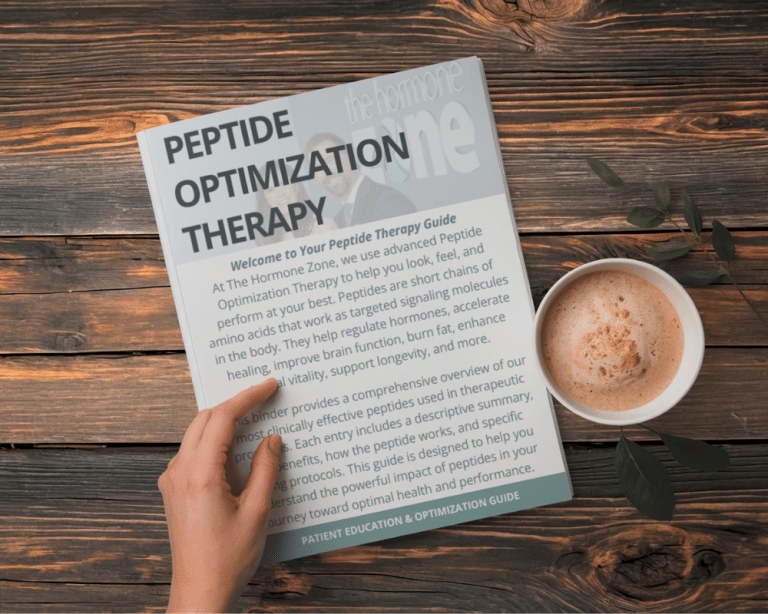
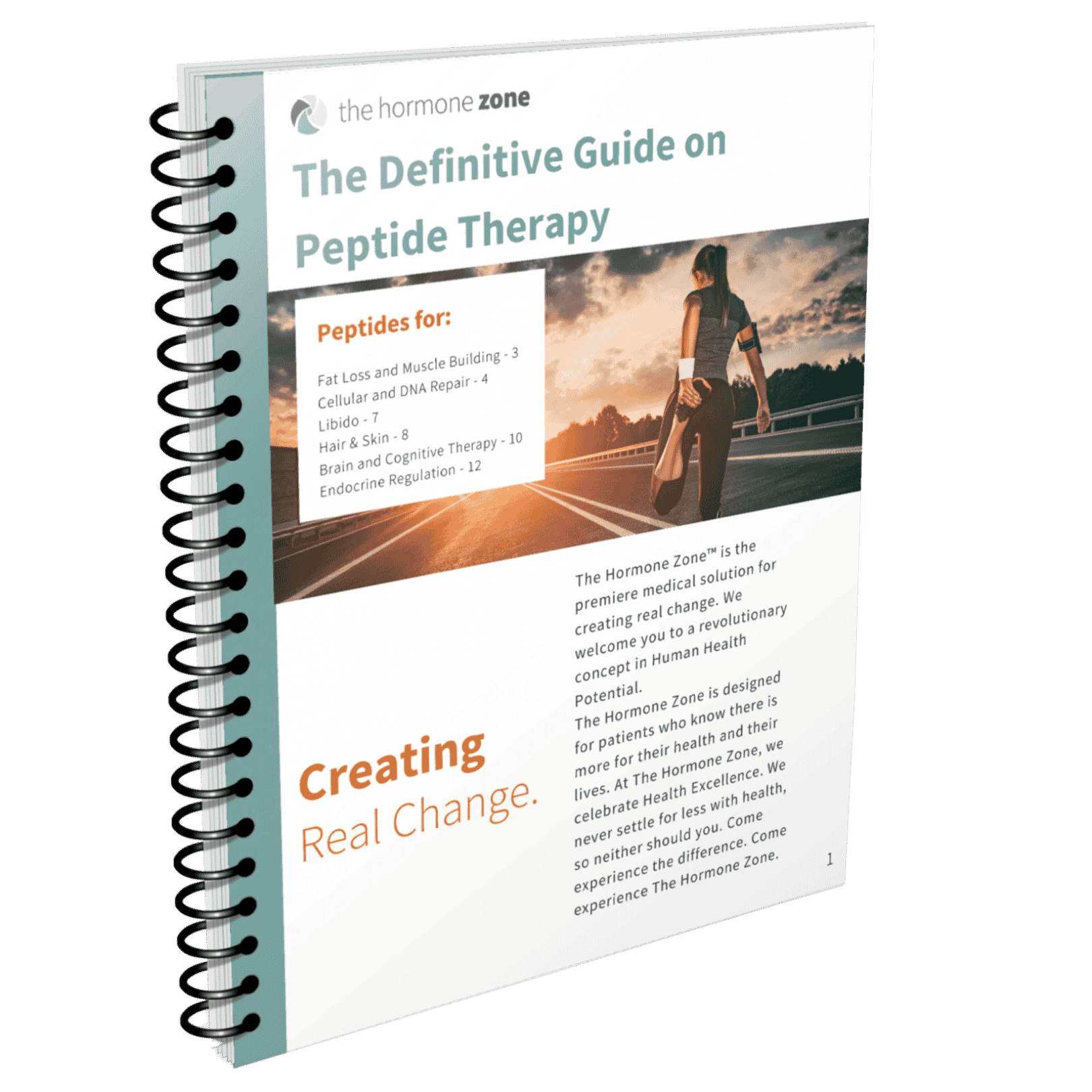
Download the Peptide Therapy Guide—A concise guide to our most effective therapeutic peptides, outlining benefits, mechanisms, and dosing to support optimal health and performance.
Get the Definitive Guide on Peptide Therapy for Free
Peptide therapy FAQs
Peptides and proteins are both composed of amino acids. All proteins consist of peptides, but not all peptides form proteins. Peptides are short chains of amino acids—between 2 and 50—while proteins are large peptides (polypeptides) consisting of longer chains of 50 or more amino acids. This gives proteins a more complex structure than peptides, and makes the smaller peptides easier for the body to absorb into the bloodstream.
Because peptides are naturally occurring in both our bodies and our food, peptide therapy is very well tolerated with extremely low instances of side effects. Any side effects are typically associated with the method of administration, such as pain, itching, or swelling at the injection site or skin irritation from a topical cream, all of which can be easily mitigated and treated. To minimize the risk of any side effects, either from application or the treatment itself, it’s important to receive peptide therapy under the professional medical guidance of experts like the physicians at The Hormone Zone. We use only the highest-quality peptides and rely on extensive, in-depth lab testing and bloodwork to ensure the appropriate dosage for maximum results.
Peptide therapy typically has a “loading” period of 3-6 months before patients realize the full effects of treatment, such as improved muscle mass and decreased fat. (A loading period is the amount of time it takes to reach maximum effect.) However, many patients begin to see improvements in sleep and energy within the first few weeks, which then begin to increase with continued use.
Peptides can work as:
- Structural components of the muscles and bone, contributing to bone shape, strength, and density as well as muscle mass and composition
- Transporters, helping chemicals like glucose travel from the blood into the muscle
- Hormones, carrying information among tissues and cells
- Enzymes, stimulating and accelerating metabolic reactions