
By Dr. John A. Robinson and Dr. Cristina Romero-Bosch
For years, we have told our patients at The Hormone Zone that menopause does not mean the ovaries suddenly become useless organs. Yes, ovarian production of estradiol and progesterone changes dramatically as reproductive function ends, but we have never believed that the absence of ovulation means the absence of function. Our position has always been simple: the human body rarely maintains an organ without purpose, and we should be cautious about removing healthy organs simply because we believe their primary function has ended.
For a woman undergoing hysterectomy for a benign condition, this is an important conversation. Removing the uterus and removing the ovaries are two very different biological events. Unless there is ovarian pathology, significant genetic risk, cancer concern, or another compelling medical reason for removal, we believe ovarian conservation deserves serious consideration. New research is giving us another reason why.
The Postmenopausal Ovary Is Not a “Dead” Organ
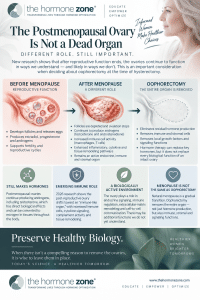
Traditionally, we have described the ovary primarily through reproduction. It develops follicles, releases eggs, and produces estradiol, progesterone and androgens. Menopause occurs as the follicular reserve becomes severely depleted and ovulation ceases, so it was easy to assume that the postmenopausal ovary had completed its biological purpose. We now know this is an oversimplification.
Human studies have demonstrated that postmenopausal ovaries can continue producing androgens, including testosterone and androstenedione. Researchers have even sampled blood directly from the ovarian veins of postmenopausal women and demonstrated ongoing ovarian androgen production. Those androgens matter because testosterone has biological activity of its own and can also serve as substrate for peripheral estrogen production throughout the body. Even from an endocrine perspective, menopause does not mean the ovary simply switches off.
A New Discovery: The Ovary May Take On an Immune Role
In 2026, researchers published a fascinating study in Molecular Human Reproduction examining what happens to the ovary after reproductive function ends. As follicles disappeared, the ovary didn’t simply become biologically silent. Instead, its molecular profile changed. Reproductive pathways decreased while pathways associated with immune function, inflammation, cytokine signaling, leukocyte activity, complement and tissue remodeling became increasingly prominent.
The researchers described this as a transition from a reproductive organ toward an “immune-like organ.” Post-reproductive ovaries demonstrated increased immune-cell populations, including macrophages and T cells, along with extensive changes within the ovarian stroma and extracellular matrix. The study was performed in mice, so we cannot assume every finding translates directly to women, but it adds to a growing body of research showing that the aging ovary remains an active biological environment involving immune cells, stromal cells, cellular senescence and signaling molecules. The ovary may change jobs after reproduction rather than simply retire.
What Else Might the Ovary Be Doing?
This is where medicine needs some humility. We understand some ovarian functions quite well, but there are almost certainly others we understand incompletely. The postmenopausal ovary appears to participate in a complex network involving endocrine signaling, immune activity, extracellular-matrix remodeling and cell-to-cell communication. Researchers are also investigating secreted factors from ovarian cells that could potentially communicate with tissues elsewhere in the body.
We do not yet know whether all of these post-reproductive functions are beneficial. Some inflammatory changes could contribute to aging rather than protect against it, but that uncertainty itself matters. This is something we have said clinically for years: the ovaries continue doing things after menopause that we understand, and it is reasonable to believe they may also be doing things we do not yet fully understand. The emerging research is beginning to validate that concept.
Oophorectomy Is Not the Same Thing as Menopause
Natural menopause represents a gradual transition in ovarian biology, while bilateral oophorectomy—the surgical removal of both ovaries—removes the entire organ. That means removing not only residual hormone production, but also stromal cells, immune cells, local growth factors, extracellular-matrix interactions and whatever additional signaling functions we have yet to characterize.
Hormone replacement therapy can replace important hormones. We use hormone therapy extensively at The Hormone Zone because estradiol, progesterone and testosterone can profoundly influence a woman’s quality of life and long-term health. But replacing hormones does not necessarily reproduce every biological function of an intact ovary, and this distinction may become increasingly important as we learn more about what the postmenopausal ovary is actually doing.
What Do Long-Term Studies of Oophorectomy Show?
Large observational studies provide another reason to think carefully before routinely removing healthy ovaries. In the Nurses’ Health Study, more than 30,000 women undergoing hysterectomy for benign disease were followed long-term. Compared with ovarian conservation, bilateral oophorectomy was associated with greater all-cause mortality, although the adverse association was particularly important among younger women who had not used estrogen therapy. Removing the ovaries also substantially reduced ovarian cancer risk, demonstrating that the decision involves genuine benefits as well as potential costs.
The evidence becomes less definitive after natural menopause. A 2026 population-based study examined 18,676 women ages 50–60 undergoing hysterectomy for benign disease. Investigators did not find significant increases in major cardiovascular events, osteoporosis or fractures after bilateral oophorectomy. However, women whose ovaries were removed were more likely to subsequently develop cardiovascular risk conditions and were approximately twice as likely to initiate menopausal hormone therapy. That does not prove that retaining postmenopausal ovaries prevents disease, but it does reinforce something fundamental: removing the ovaries after menopause is not necessarily biologically neutral.
When Should Ovaries Be Removed?
There are absolutely situations in which oophorectomy is appropriate. Known or suspected ovarian malignancy, concerning ovarian pathology, certain high-risk genetic mutations, significant family-history considerations and other individual clinical circumstances can change the risk-benefit equation considerably. This is not an argument that ovaries should never be removed; it is an argument against the assumption that “you’re done having children, you’re menopausal, so you don’t need them anymore.”
When a woman is undergoing hysterectomy for a benign condition and has healthy ovaries without a compelling indication for their removal, ovarian conservation should be part of an individualized discussion with her surgeon. Menopause and surgical removal of the ovaries are biologically different events, and increasingly the science suggests that distinction matters.
Medicine Is Rediscovering the Postmenopausal Ovary
For decades, women’s reproductive organs have been viewed primarily through fertility. Once reproduction ended, their biological importance was assumed to diminish dramatically, but biology appears to be much more complicated. The ovary doesn’t disappear at menopause. Its cellular composition changes, its hormonal output changes, its immune environment changes, its stromal architecture changes, and its communication with the rest of the body may change.
Menopause increasingly appears to represent a transition in ovarian function—not simply the end of ovarian function. At The Hormone Zone, that reinforces something we have believed for a long time: preserve healthy biology whenever there isn’t a compelling reason not to. We should certainly remove an organ when disease or meaningful risk makes removal appropriate, but we should be much more thoughtful about removing a healthy organ simply because we assume its usefulness has expired. Twenty years from now, we will almost certainly understand considerably more about the postmenopausal ovary than we do today, and we may discover that nature had very good reasons for leaving it there.
Sources
Converse A, et al. The post-reproductive ovary shifts from a reproductive to an immune-like organ. Molecular Human Reproduction. 2026.
Fogle RH, Stanczyk FZ, Zhang X, Paulson RJ. Ovarian androgen production in postmenopausal women. Journal of Clinical Endocrinology & Metabolism. 2007;92(8):3040–3043.
Parker WH, et al. Long-term mortality associated with oophorectomy compared with ovarian conservation in the Nurses’ Health Study. Obstetrics & Gynecology. 2013;121(4):709–716.
Parker WH, et al. Ovarian conservation at the time of hysterectomy and long-term health outcomes in the Nurses’ Health Study. Obstetrics & Gynecology. 2009.
Abreu do Valle H, et al. Health outcomes following oophorectomy during benign hysterectomy in those who are in postmenopausal ages: a population-based study. American Journal of Obstetrics & Gynecology. 2026;235(3):555–565.
This article is for educational purposes and is not intended to replace individualized medical advice. Decisions regarding hysterectomy, ovarian conservation, oophorectomy and hormone therapy should be made based on each woman’s individual medical history and risk profile.