
By Dr. John A. Robinson, NMD & Dr. Cristina Romero-Bosch, NMD
The Hormone Zone®
For decades, conventional medicine has approached testosterone deficiency largely through the question: How low is low enough? A man may report declining energy, loss of muscle, increasing abdominal fat, diminished sexual desire, poor recovery, or changes in mood, yet still be told that his testosterone is “normal.”
A 2026 review published in the Journal of Endocrinological Investigation helps explain why we believe this approach deserves reconsideration. The authors describe male hormonal aging not as an isolated decline in testosterone, but as an interconnected process involving metabolic health, visceral fat, insulin resistance, inflammation, sleep, cardiovascular function, muscle, bone and sexual health.
This is much closer to how we have approached men’s hormone health at The Hormone Zone for many years.
The Difference Between a Reference Range and a Functional Range
The American Urological Association framework cited in the review uses a total testosterone below 300 ng/dL, confirmed on two separate morning measurements in a symptomatic man, as its biochemical threshold. The European framework cited in the paper uses approximately 346 ng/dL. Importantly, the authors emphasize that there is no universally accepted biochemical definition of late-onset hypogonadism.
At The Hormone Zone, we approach this differently. In our clinical practice, we commonly use a functional therapeutic range of approximately 700–1,100 ng/dL for total testosterone, interpreted alongside free testosterone, SHBG, estradiol, symptoms, body composition, metabolic health and the patient’s response to treatment.
This is our clinical therapeutic framework, not the diagnostic cutoff proposed by this review or conventional guidelines. Our concern is that waiting until testosterone reaches 300 may mean waiting until hormonal and metabolic decline has become much more advanced.
We would rather identify that trajectory earlier, when associated problems are just beginning—or before several have accumulated.
Testosterone Decline Doesn’t Occur in Isolation
The European Male Aging Study data discussed in the review found that total testosterone declines approximately 0.4% per year while free testosterone declines about 1.3% per year. Rising SHBG with age contributes to the more substantial reduction in free testosterone.
The consequences extend far beyond libido. The review describes reduced sexual function, fatigue, declining muscle mass and strength, increasing visceral fat, reduced bone density, and mood and cognitive changes. Obesity, metabolic syndrome and chronic illness can amplify these problems.
This raises an important question: Why wait for this constellation of dysfunction to become established before paying attention to the hormonal environment in which it is developing?
By the time a symptomatic man’s testosterone reaches 300, we may no longer be looking at an isolated hormone problem. We may be dealing with years of accumulated changes in body composition, insulin sensitivity, inflammation, sleep, cardiovascular health and sexual function.
Testosterone Is a Metabolic Hormone
One of the most important messages from this review is that testosterone should not simply be considered a sex hormone.
Testosterone acts on skeletal muscle, adipose tissue, liver and pancreatic beta cells. It supports glucose uptake and insulin sensitivity in muscle, influences visceral fat and lipid metabolism, participates in insulin secretion, and supports protein synthesis and preservation of lean tissue.
This creates the potential for a vicious cycle. As testosterone declines, maintaining muscle can become more difficult while visceral adiposity and insulin resistance increase. Those metabolic changes contribute to inflammation, while inflammation itself can further suppress testosterone production.
The review describes higher inflammatory activity in men with lower testosterone and evidence that inflammatory cytokines including IL-1β, TNF-α and IL-6 can suppress testosterone synthesis. Testosterone deficiency and inflammation may therefore reinforce one another.
This is one of our strongest arguments for earlier recognition and intervention. The goal is to address the hormonal and metabolic environment while dysfunction is developing rather than waiting until multiple comorbidities are firmly established.
Functional Hypogonadism Changes the Conversation
The authors make an important distinction between classical hypogonadism and functional hypogonadism.
Functional hypogonadism can occur when obesity, insulin resistance, chronic inflammation and sleep disorders suppress the HPG axis without structural testicular or pituitary disease. Addressing weight, exercise, metabolic health and sleep may therefore improve endogenous testosterone production in some men.
We agree with this concept, but earlier recognition is critical. Intervention does not automatically mean testosterone therapy for every man whose level falls below 700. Hormone medicine should never be reduced to treating a number. Instead, it means recognizing the direction in which the patient’s physiology is moving.
Is visceral fat increasing? Is insulin sensitivity deteriorating? Is he losing muscle despite training? Has sleep deteriorated? Is inflammation increasing? Has libido changed? Has free testosterone fallen disproportionately because SHBG has increased?
These questions matter long before a laboratory report finally labels testosterone “low.”
Sleep Is Part of Hormone Health
The review also highlights the intimate relationship between sleep and testosterone. Testosterone secretion is linked to sleep architecture, particularly slow-wave sleep. Sleep fragmentation, insomnia, circadian disruption and obstructive sleep apnea can interfere with normal testosterone production. Experimental sleep restriction has produced a 10–15% reduction in testosterone after only one week.
This is why good hormone medicine cannot consist simply of prescribing testosterone. Sleep, body composition, nutrition, exercise, insulin sensitivity, inflammation and cardiovascular health belong in the same conversation.
Treat the Man, Not the Threshold
Perhaps one of the most important observations in the review is that symptoms associated with androgen deficiency do not always correspond neatly with serum testosterone concentrations. The authors suggest that this disconnect challenges a purely biochemical definition of hypogonadism and supports a more symptom-centered, integrated clinical framework.
That closely reflects the philosophy we have developed through decades of treating hormone patients.
We do not believe 700–1,100 ng/dL represents a universal diagnostic definition of hypogonadism, nor that every man should automatically receive testosterone therapy to reach that range. It is the functional therapeutic range we commonly use when clinically appropriate, while evaluating free testosterone, estradiol, SHBG, symptoms, metabolic markers, body composition, cardiovascular risk, prostate health and hematologic parameters.
The larger issue is when we intervene.
Waiting until testosterone falls below 300 can mean allowing years of declining muscle, increasing visceral adiposity, worsening metabolic health, deteriorating sleep and declining sexual function to occur before hormone health receives serious attention. The paper’s model of male aging connects hormonal decline directly with metabolic dysfunction, sleep disruption, cardiovascular aging and inflammatory pathways.
At The Hormone Zone, our goal is not simply to prevent testosterone from becoming severely low. It is to recognize the trajectory earlier, understand what is driving it, and intervene while many of these associated changes are just beginning rather than already established.
That is the difference between waiting for disease and practicing proactive hormone medicine.
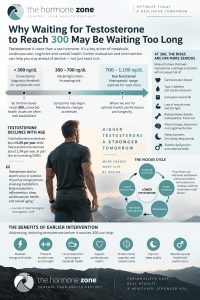
Source: Andersen ML, Sanches JM, Alvarenga TA, et al. Late-onset and functional hypogonadism in aging men: an integrated perspective on hormonal, sleep, and metabolic dimensions. Journal of Endocrinological Investigation. 2026.